
A clicking sound, slight movement, or unusual pressure around an implant crown may point to a loose connecting screw. The problem can feel alarming, but it does not necessarily mean the implant has failed. Understanding how the components fit together, why connections loosen, and what repair involves can help patients respond early and avoid further damage to their replacement tooth.
When Your Implant Crown Suddenly Feels Different
You’re halfway through lunch when you notice a faint click each time you chew. Nothing hurts, but one of your replacement teeth suddenly feels different. You run your tongue across it, wondering whether something has shifted.
A loose connecting screw could explain the sensation. However, the implant itself may still be firmly attached to your jawbone. Identifying which part has moved is important because a loose crown connection and a failing implant are two different problems.
The Tiny Connection Hidden Beneath Your Crown
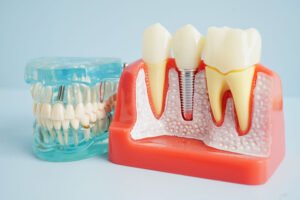
Once treatment is complete, dental implants look and function much like natural teeth. Behind that familiar appearance is a system of connected parts. The implant fixture sits inside the jawbone, while an abutment links it to the visible crown.
A small screw often holds the abutment or crown assembly in place. Tightening it creates a clamping force called preload, which keeps the components firmly joined during chewing. When that force decreases, unwanted movement can develop between the connected surfaces.
Implant screws are designed to withstand everyday biting pressure, but their stability depends on proper installation, component fit, and the forces placed on the restoration.
One Wobbly Tooth, Several Possible Explanations
A crown that moves doesn’t automatically mean the implant has lost its attachment to the jawbone. Sometimes the abutment screw loosens, the crown separates from its connector, or a prosthetic component becomes damaged. Each situation requires a different repair.
Actual implant mobility is more concerning because it may indicate a problem with the fixture’s supporting bone. A dentist can examine the crown, assess movement, and use dental X-rays when necessary to determine where the problem begins.
The difference isn’t always obvious to patients. What feels like an unstable implant may turn out to be a mechanical issue involving a replaceable component.
Why Would a Metal Screw Loosen After Months of Normal Chewing?
Your implant crown handles repeated pressure throughout the day. Chewing creates forces that travel through the crown, abutment, and implant fixture. When those forces are uneven or excessive, the screw connection may gradually lose stability.
Even metal surfaces that appear perfectly smooth contain microscopic irregularities. After tightening, these surfaces can settle against one another, slightly reducing the screw’s original clamping force. Clinicians call this embedment relaxation or the settling effect.
Nighttime grinding adds another challenge. People who clench or grind their teeth may place repeated sideways pressure on implant restorations. Unlike natural teeth, implants lack the periodontal ligament that provides some cushioning and sensory feedback.
Crown fit, screw design, implant connection geometry, and tightening technique also influence mechanical stability. A loose screw rarely has one universal explanation, which is why identifying the contributing factors matters.
The Signs May Be Easy to Miss
A loose connection doesn’t always cause pain. Some patients notice something unusual only when chewing, speaking, or cleaning around the replacement tooth.
Watch for changes such as:
- A clicking sensation: A faint sound or movement when biting down or releasing pressure.
- An unstable crown: The replacement tooth feels slightly different when touched by your tongue.
- Changes in your bite: One tooth seems to contact the opposing teeth earlier than before.
- Difficulty chewing: Previously comfortable foods produce unfamiliar pressure or movement.
These symptoms can also occur with other dental problems. Avoid repeatedly pushing or twisting the crown to test its stability. A clinical examination is the safest way to identify the cause.
What Actually Happens During a Screw Repair?
Repair begins with understanding how the crown was attached. Some implant crowns are screw-retained and have a small access opening concealed beneath tooth-colored filling material. Others are cement-retained, which may make the connecting screw harder to reach.
Once the connection is accessible, the dental professional examines the screw, abutment, and internal implant surfaces. Damaged parts may need replacement, while reusable components can sometimes be cleaned and reassembled. The screw is tightened according to the implant manufacturer’s recommended torque when appropriate.
A screw-retained restoration may be relatively straightforward to access. Cement-retained crowns can require additional steps, and preserving the existing crown isn’t always possible.
The appointment isn’t simply about making the tooth feel tight again. The clinician must also confirm that the restoration fits correctly and that the original problem has been addressed.
Will You Need Another Implant Surgery?
Patients sometimes associate any implant complication with the operation they underwent when the fixture was first placed. Although implant treatment involves surgery to position the fixture in the jawbone, repairing a loose prosthetic screw often does not require another operation.
If the implant remains stable and its internal connection is undamaged, treatment may involve only the crown and connecting hardware. More serious complications, including a fractured fixture or loss of bone integration, can require a different approach.
The extent of treatment depends on the examination findings rather than the clicking sensation alone.
Why Ignoring the Movement Can Become Expensive
A loose connection allows parts that should remain firmly joined to move against one another. Continued chewing may wear the connecting surfaces, damage screw threads, or contribute to component fracture. The crown could also become detached unexpectedly.
Until your dental appointment, avoid chewing on the affected side and leave the restoration alone. Don’t attempt to tighten it with household tools or secure it using glue. If a component falls out, place it in a clean container and bring it to your appointment.
Prompt evaluation may help prevent additional mechanical damage. Severe swelling, fever, uncontrolled bleeding, or difficulty swallowing calls for urgent medical assessment.
A Second Loose Screw Changes the Conversation
When the same screw loosens repeatedly, tightening it again may provide only temporary relief. Something about the restoration, bite, or connecting components could be placing unusual stress on the screw.
Your dental professional may examine how the upper and lower teeth meet, whether the crown is properly seated, and whether the connection shows signs of wear. People who grind their teeth may benefit from bite adjustments or a professionally fitted nightguard when clinically appropriate.
Repeated loosening is a reason to investigate the entire restoration rather than treating the screw as an isolated problem.
Questions That Come Up When an Implant Crown Starts Moving
Q1. Can a loose implant screw tighten itself again?
A1. No. Normal chewing cannot reliably restore the screw’s required clamping force. Professional tightening or component replacement is needed after the connection has been examined.
Q2. Is implant screw loosening considered implant failure?
A2. Not necessarily. Screw loosening is a mechanical complication involving the restoration. Implant failure generally concerns the fixture’s stability or integration within the supporting jawbone.
Q3. Can a loose implant screw cause gum irritation?
A3. Yes. Movement or changes in crown positioning may irritate nearby tissues or create spaces where plaque collects. Redness, swelling, or bleeding should be evaluated professionally.
Q4. How long does an implant screw repair take?
A4. Appointment length depends on how easily the screw can be accessed and whether any components are damaged. Simple adjustments may require one visit, while complicated repairs can take longer.
Q5. Can a broken implant screw be removed?
A5. Sometimes. Specialized instruments may help retrieve fractured screw fragments. The outcome depends on the fragment’s position and the condition of the implant’s internal threads.
Q6. Does a new implant crown require a different screw?
A6. Not always. Replacement components must be compatible with the specific implant system. Your dental professional will determine which existing parts are suitable for reuse.
Q7. Are screw-retained crowns better than cement-retained crowns?
A7. Both designs have advantages. Screw-retained crowns generally allow easier access for certain repairs, while cement-retained crowns may be suitable when implant positioning or restoration design requires them.
Q8. Can implant screws loosen despite regular dental checkups?
A8. Yes. Routine examinations help identify developing complications, but they cannot prevent every mechanical issue. Changes in chewing forces or component wear may occur between appointments.
Your Replacement Tooth Should Feel Secure
An implant crown that shifts or clicks while chewing may have a loose connection rather than a problem with the implant itself. A dental examination can identify the affected component and help determine the next step.
Greenwood Dental Partners offers dental implant and restorative care for patients dealing with these concerns. If you’ve noticed a change in your replacement tooth, the team can help you explore suitable treatment options in Burlington, MA.